
SWIR Imaging Application Note
Author: Bryan Ng – Marketing Manager
Published on:
Last edited:

1. Introduction

Short-wave infrared (SWIR) light is a part of the electromagnetic spectrum, typically in the 0.9μm to 2.5μm (900nm to 2500nm) wavelength range and is therefore invisible to the human eye.
However, SWIR light interacts with objects in a similar manner to visible wavelengths in that photons are reflected by the object itself. As a result of this reflective nature, SWIR light has contrast and shadows in the images it produces, which are a necessary requirement for high-resolution imaging.
SWIR is unlike Mid-Wave Infrared (MWIR) and Long-Wave Infrared (LWIR) light, which is emitted from an object as thermal IR (heat) and therefore has lower resolution and shows less detailed images.
SWIR wavelengths can only be seen by sensors such as Indium Gallium Arsenide (InGaAs). Images from InGaAs camera sensors are comparable in detail and resolution to visible light images, but are not in color. This is one of the many advantages of SWIR as it allows objects to be more easily recognized and individually identified.
2. Operation Principle
To achieve these high-resolution images, it is essential to use a lens that is specifically designed and coated for the SWIR wavelength range.
Using a lens designed for the visible spectrum will result in lower-resolution images and higher optical aberrations. Since SWIR wavelengths are transmissible through glass, then lenses and other optical components (optical filters, windows, etc.) designed for SWIR can be manufactured using the same techniques used for visible components. This leads to lower manufacturing costs and enables the use of protective windows and filters within the optical system.
3. SWIR Imaging Applications
A large number of SWIR imaging applications that are difficult or impossible to perform using visible light are possible using SWIR.
3.1 Seeing in Low Light Conditions – Night Vision
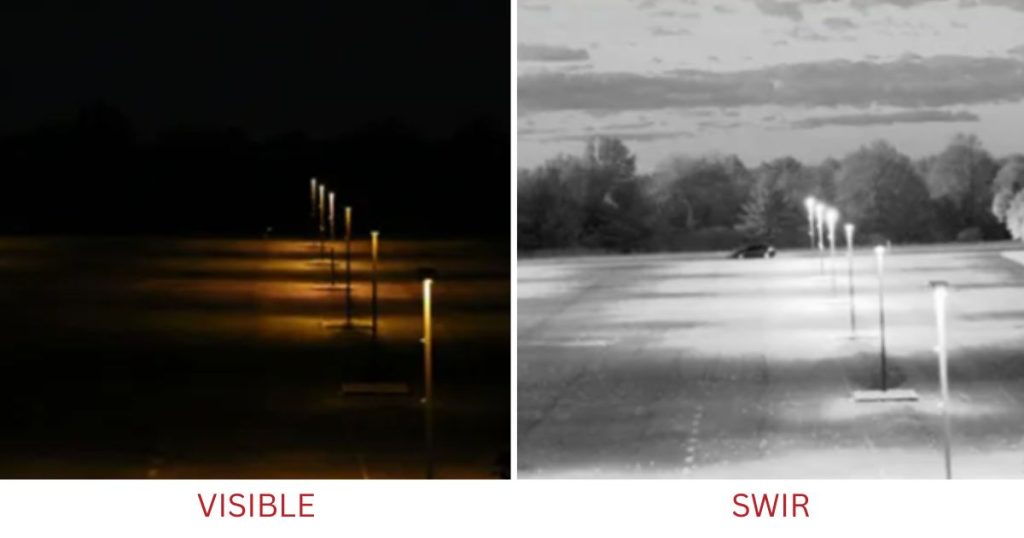
The image on the left was captured two hours after sunset on a full moon night, at a distance of 250 meters. The visible light image was captured using a Canon 5D Mark III with a 115mm f/4.5 lens, with a forced exposure of 1/30 second and ISO 12800.
The image on the right was captured at a range of 250m, two hours after sunset, on a full-moon night. The SWIR imaging above was captured using a high-definition 1280×1024 JSX camera. The image was captured using a 50mm f/1.4 SWIR-optimized lens with an exposure setting of 1/30 second. Due to the ambient irradiance of the night sky, the high-gain SWIR camera can produce clear nighttime images over visible light images.
3.2 Seeing Through Smoke and Fire

Light with longer wavelengths can more easily pass through atmospheric obscurants such as dust, haze, and smoke. Because the SWIR band has longer wavelengths than visible light, SWIR cameras can image scenes behind light smoke, as shown in the forest fire image on the right.
3.3 Maritime Applications

Left: A thermal camera detects temperature contrast. Because swimmers have a similar temperature to the water, they easily blend in with the background. This is called thermal crossover.
Right: SWIR cameras detect reflected light similarly to visible light cameras. Due to the high absorption rate of SWIR light in water, the swimmer shown in the SWIR imaging exhibits high image contrast, making it easier to detect.
3.4 Disguise Detection
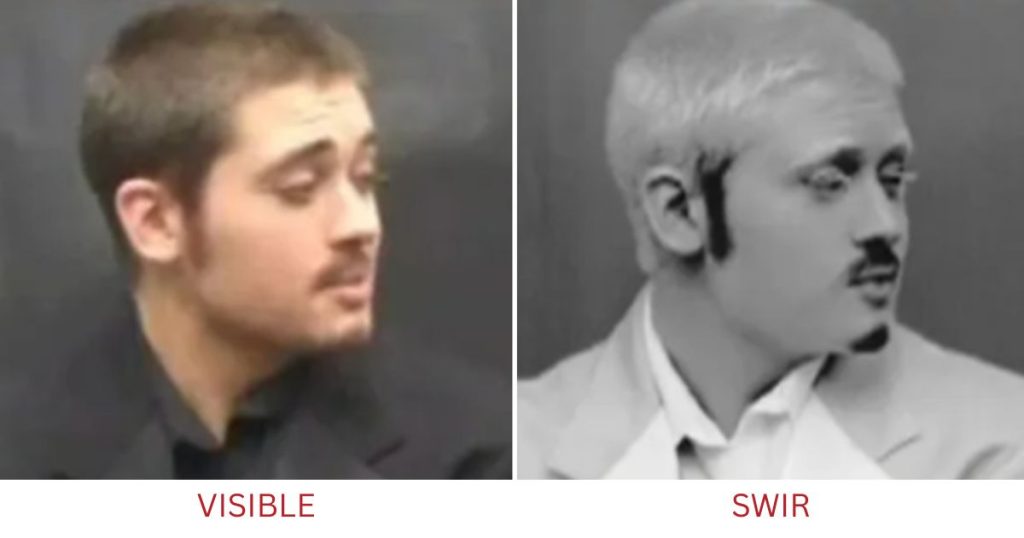
The visible light image on the side shows an actor wearing artificial facial hair, which is nearly undetectable to visible light cameras. The SWIR imaging (right) easily defeats the disguise worn by the actor. Human hair and natural fabrics (such as cotton) are highly reflective in the SWIR. Notice how in the SWIR imaging, the actor’s natural hair meets the artificial facial hair worn in the disguise. Also note how the actor’s black suit and shirt appear white in the SWIR.
3.5 Driver Vision Enhancement

Left: Visible image taken from a vehicle with its headlights turned off on a nearly moonless night.
Right: A SWIR imaging of the same scene captured using a SWIR illuminator that is undetectable to the human eye. Sensors Infinity SWIR cameras can be incorporated into vehicle platforms to enhance driver vision in complete darkness.
3.5 Seeing Through Glass

Left: Thermal image of a glass window using a long-wave infrared (LWIR) imager.
Right: SWIR imaging of the same scene. SWIR light interacts with objects similarly to visible light, thus producing familiar images through glass windows. Notice that the cars in the parking lot have shadows similar to those produced by a visible light camera.
3.6 Industrial Inspection
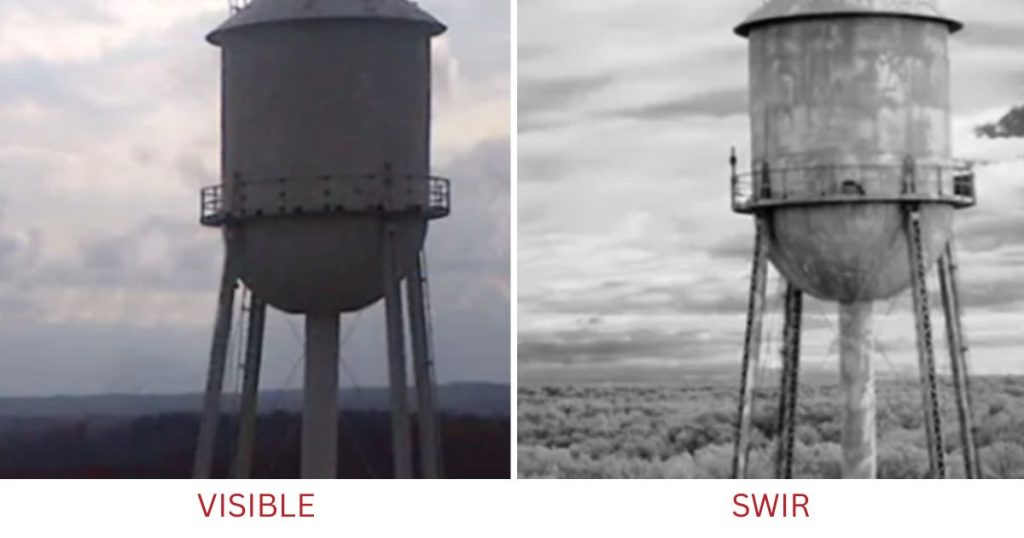
Left: Visible image of the water tower captured with a cell phone camera.
Right: SWIR imaging of the same scene. SWIR cameras detect longer wavelengths of light than visible light cameras, causing the various layers of paint on the water tower to appear in the SWIR image.
3.7 Commercial / Building Diagnostic
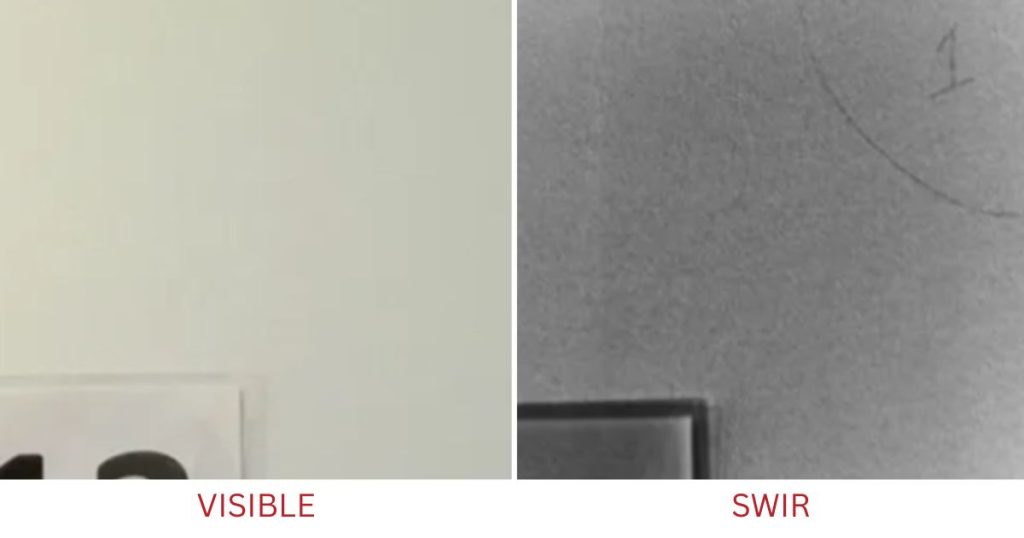
Left: Visible image of the interior wall of a commercial building captured with a mobile phone camera.
Right: Maintenance and repair work is costly for residential and commercial building owners. Every interior and exterior wall contains valuable information beneath the painted surface. Use infrared inspection cameras to quickly identify studs and structural elements, as well as detailed information about electrical, HVAC, water, and security systems. Discover hidden moisture patterns and identify potential plumbing or exterior leaks before they spread.
3.8 Food Inspection

Left: Visible and SWIR image of an apple. SWIR light is highly absorbed in water, making the bruised portion of the apple easily detectable in SWIR.
Right: Visible and SWIR image of an apple. SWIR light is highly absorbed in water, making the bruised portion of the apple easily detectable in SWIR.
3.9 Tonardo Research
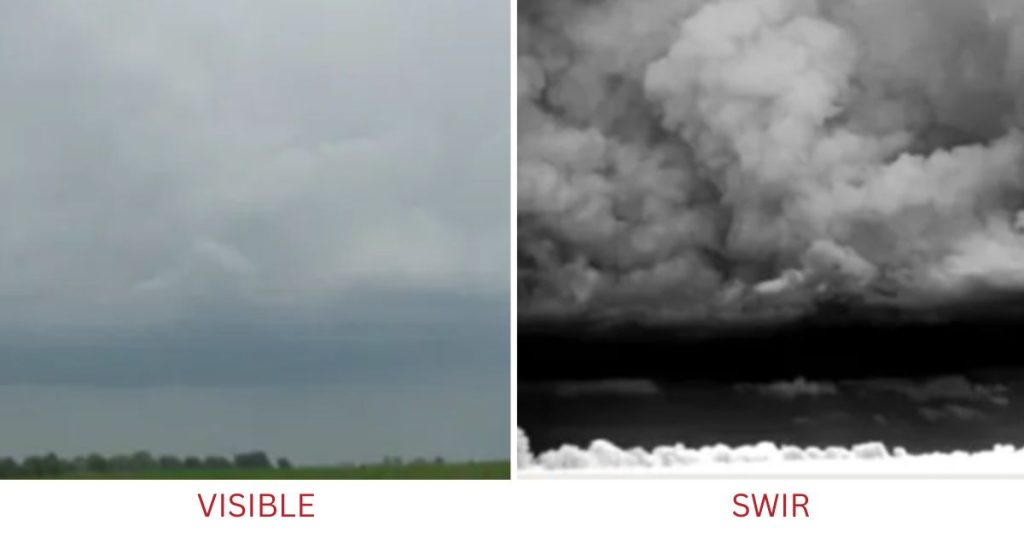
Left: The base of a thunderstorm cloud visible near Lebanon, Indiana, on June 15, 2016.
Right: SWIR thunderstorm base near Lebanon, Indiana, on June 15, 2016, showing higher dynamic range and enhanced cloud texture detail in the SWIR image.
3.10 Penetrating Atmosphere Obscurants
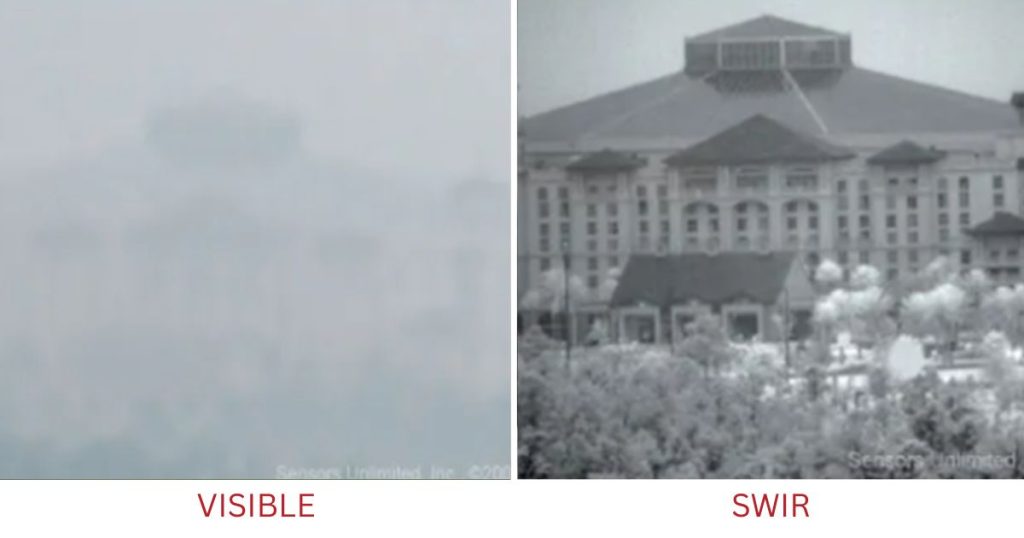
SWIR InGaAs cameras are capable of capturing images through rain, haze, smoke, and other obscurants. The visible image on the left cannot be detected. However, the SWIR camera can see through atmospheric obscurants to determine the cause. The image on the right was taken in the evening before dusk, approximately 150 feet above the ground. The distance shown here is approximately 1.5 miles from the camera.
4. Conclusion
SWIR imaging bridges the gap between visible and thermal infrared sensing, providing high-resolution, high-contrast imaging in challenging lighting and environmental conditions. Its versatility makes it indispensable in industrial automation, security, environmental monitoring, and scientific research.
