
Femtosecond Laser Optics: Engineering for the Shortest Pulses in Photonics
Author: Bryan Ng – Marketing Manager
Published on:
Last edited:
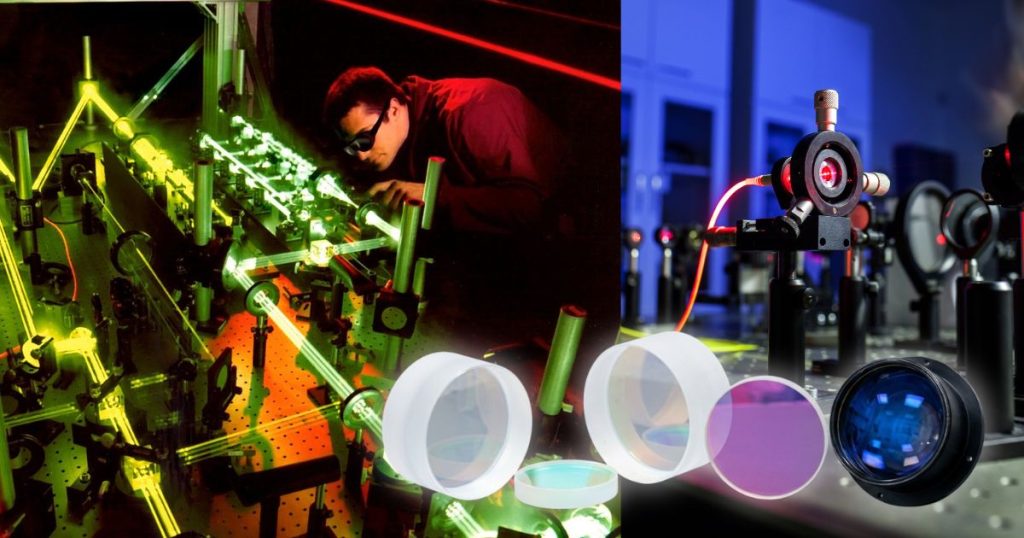
A femtosecond laser pulse lasts somewhere between roughly ten and a thousand quadrillionths of a second — so brief that light itself, moving at nearly 300,000 kilometers per second, travels only a few micrometers to a few tens of micrometers during the pulse. Compressing that much energy into that little time produces peak powers intense enough to vaporize the hardest ceramics, reshape human corneal tissue without burning it, and drive nonlinear optical effects that simply don’t occur under ordinary illumination.
That extraordinary capability comes with an equally extraordinary engineering burden, and most of it falls on the optics. A femtosecond laser source can be perfectly designed, but if the mirrors, lenses, and windows carrying its beam aren’t built to femtosecond-specific standards, the pulse degrades before it ever reaches the workpiece. Understanding what makes femtosecond laser optics different — and what to look for when specifying them — matters as much as understanding the laser source itself.
1. Why Femtosecond Laser Optics Break Conventional Optics Rules
Standard laser optics, the kind built for continuous-wave or nanosecond-pulse systems, are engineered around a fairly forgiving set of requirements: get the coating reflective or transmissive at the right wavelength, keep the surface smooth enough to avoid scattering, and make sure the damage threshold comfortably exceeds the operating power. These are solved problems, achievable with well-established manufacturing processes.
Femtosecond systems operate under a different set of physical constraints entirely, and two of them dominate everything else in the design process: damage threshold and dispersion.
1.1 Damage Threshold: Peak Power Changes Everything
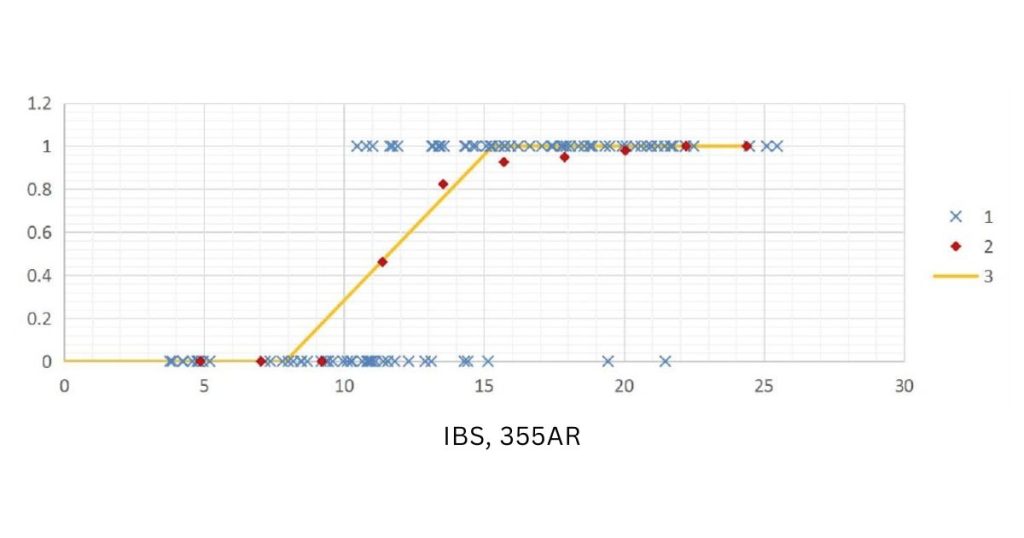
Because a femtosecond pulse concentrates so much energy into such a short window, its peak intensity can be orders of magnitude higher than a nanosecond pulse carrying the same average power. A femtosecond laser running at just a few watts of average power can generate peak intensities capable of instantly damaging an optical surface that isn’t specifically engineered to survive it. Industry data bears this out starkly: the laser-induced damage threshold (LIDT) required for femtosecond laser optics is typically only a tenth to a twentieth of what’s needed for nanosecond systems, even though the peak power density involved can be two to three orders of magnitude higher. That gap is exactly why femtosecond laser optics can’t simply be a higher-spec version of a standard laser mirror — they require a fundamentally different approach to coating design, substrate purity, and surface finish.
1.2 Dispersion: The Enemy of Pulse Duration
The second challenge is dispersion — the tendency of different wavelengths of light to travel at slightly different speeds through any transparent material, including glass, crystal, and even air. For a nanosecond pulse, whose spectral bandwidth is vanishingly narrow, dispersion is a non-issue. A femtosecond pulse, by contrast, is necessarily broadband — physics dictates that the shorter the pulse, the wider the range of wavelengths it must contain — which means dispersion has real material to work with. A 50-femtosecond pulse can stretch to several times its original duration after passing through just a few millimeters of ordinary optical glass, diluting peak power and degrading the very precision that made a femtosecond laser worth using in the first place.
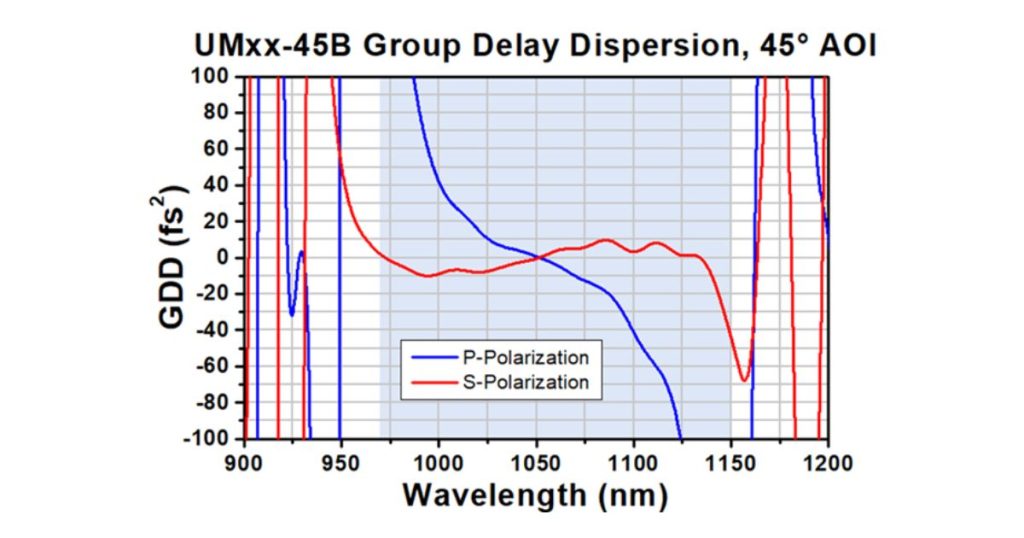
Managing this stretching effect, known as group delay dispersion (GDD), is one of the central engineering problems in femtosecond laser optics. It’s addressed through careful substrate selection, specialized coating architectures, and dedicated dispersion-compensation components — a design discipline that has no real equivalent in conventional laser optics.
1.3 Surface Precision Requirements Beyond Typical Tolerances
Beyond damage threshold and dispersion, femtosecond laser optics also demand exceptionally tight surface figure accuracy, wavefront error control, and coating uniformity. In a system where multiple optical components sit in series, even small imperfections at each surface accumulate into meaningful phase distortion by the time the beam reaches its target — degrading both spot quality and processing precision. This is why surface figure specifications for critical femtosecond components are often held to a fraction of a wavelength, tolerances that would be considered unnecessary in most other areas of the optics industry.
2. The Femtosecond Laser Optics That Make Femtosecond Systems Work
A complete femtosecond laser system is built from several functional stages, each of which places distinct demands on its optics.
The oscillator, which generates the seed pulse, typically relies on gain media such as Ti:Sapphire or Yb-doped crystals and fiber. The cavity mirrors inside it need extremely high reflectivity, near-zero group delay dispersion, and a damage threshold capable of surviving continuous circulation of the pulse — all at once. Waveplates inside the cavity need broad bandwidth and minimal added dispersion, since even small amounts of phase distortion accumulate every time the pulse makes another round trip.
Dispersion-compensation optics are where much of femtosecond engineering’s real complexity lives. Chirped mirrors — multilayer dielectric coatings engineered so that different wavelengths penetrate to different depths before reflecting — introduce a precisely controlled negative dispersion that offsets the positive dispersion the pulse picks up elsewhere in the system. Grating pairs and prism pairs serve a similar function with tunable compensation, and are especially common in chirped pulse amplification (CPA) systems, where a pulse is deliberately stretched before amplification and recompressed afterward to avoid damaging the amplifier itself.
The amplifier stage, used in CPA systems to scale pulse energy by several orders of magnitude, introduces its own set of optical requirements: gain crystals that manage thermal load without distorting the beam, pump-coupling lenses with high damage threshold and precise numerical aperture matching, and optical isolators to keep back-reflections from destabilizing the seed oscillator.
Beam delivery and focusing optics — lenses, windows, and steering mirrors — need surface figure and roughness control tight enough that they don’t introduce their own phase errors, along with damage threshold performance suited to the peak intensities involved. In scanning applications like laser marking or micromachining, F-theta lenses designed specifically for femtosecond bandwidths matter more than they might seem to: a standard F-theta lens, optimized for a single wavelength, can badly distort focus quality when fed a broadband femtosecond pulse, while a properly designed ultrafast F-theta lens preserves spot roundness and edge sharpness across the scan field.
Nonlinear optical crystals, such as BBO, LBO, KTP, and MgO-doped lithium niobate, are used for wavelength conversion processes like second- and third-harmonic generation. These need precise phase-matching, strong nonlinear response, and the ability to survive peak intensities well beyond what conventional laser crystals are designed for.
3. Applications: Where Femtosecond Precision Actually Pays Off
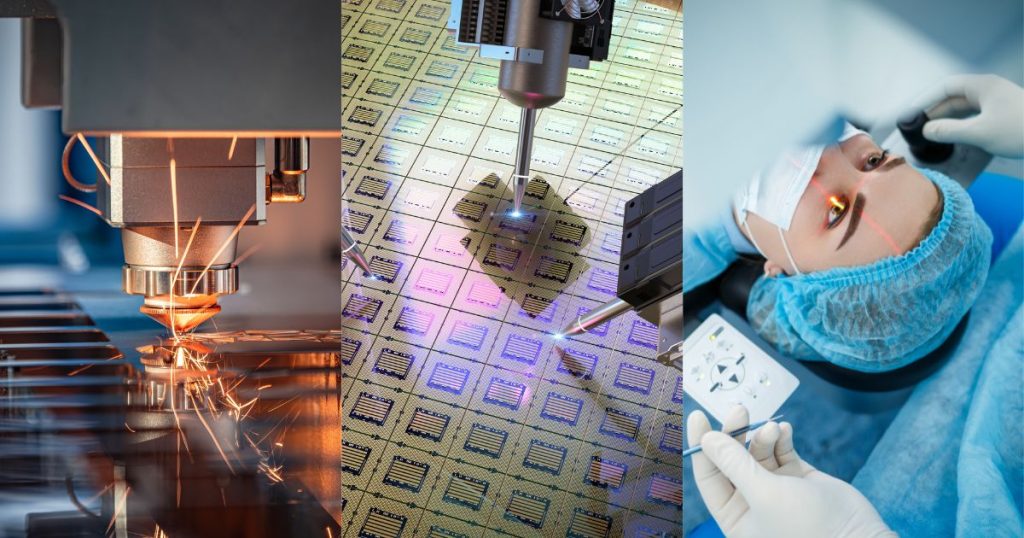
Femtosecond lasers earn their cost premium in applications where heat-affected zone has to be essentially zero, or where processing precision at the micron scale is non-negotiable:
- Precision manufacturing and electronics: OLED and LCD glass cutting, sapphire and ceramic cover glass drilling, PCB via drilling, and ultra-thin copper foil etching all rely on femtosecond “cold ablation” — material removal that happens faster than heat can diffuse into surrounding material, avoiding cracking, burring, or discoloration.
- Semiconductor and battery manufacturing: Wafer dicing and scribing, direct laser writing, chip packaging, and through-silicon via etching benefit from femtosecond precision, as does cutting and welding of lithium battery tabs and electrodes, where thermal damage to adjacent structures isn’t tolerable.
- Medical and ophthalmic applications: Blade-free corneal incisions in LASIK surgery are one of the most well-known femtosecond applications, alongside precision fabrication of vascular stents, microfluidic chips, and interventional catheters — contexts where thermal damage to surrounding tissue or delicate structures simply isn’t an option.
- Scientific research: Multiphoton microscopy, ultrafast spectroscopy, and frequency-comb metrology all depend on preserving pulse duration and beam quality through complex optical setups, making dispersion-managed optics a foundational requirement rather than a nice-to-have.
4. What to Look For When Specifying Femtosecond Laser Optics
A few practical questions tend to separate a well-specified femtosecond laser optics purchase from one that leads to disappointing system performance:
- Is the GDD specification given across your actual operating bandwidth, not just at a single wavelength? Femtosecond pulses are inherently broadband, so a mirror’s dispersion behavior needs to be understood across the full spectral width of the pulse.
- Is damage threshold data measured under conditions resembling your application — similar pulse duration, repetition rate, and spot size — rather than a generic headline number?
- What surface figure and roughness tolerances does the component carry, and are they tight enough to avoid contributing measurable wavefront distortion when combined with the rest of your beam path?
- Is the coating process suited to ultrafast requirements? Not all coating techniques can simultaneously deliver the combination of high reflectivity, ultra-low absorption, and precise dispersion control that femtosecond laser optics demand — this is a real differentiator between suppliers.
- Does the supplier offer full optical and dimensional metrology data with each component, so you can verify performance rather than take a spec sheet on faith?
5. Where Wavelength Opto-Electronic Fits In
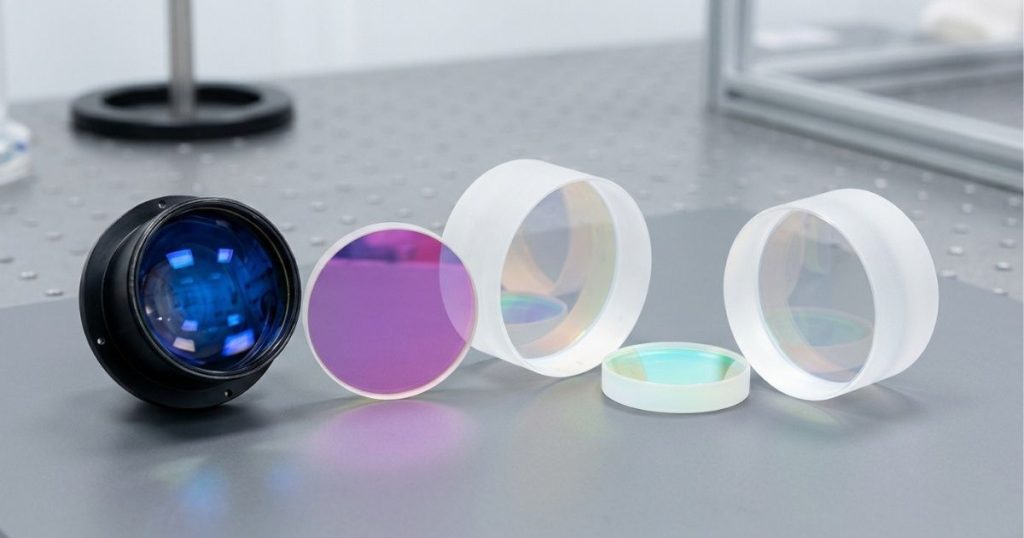
Femtosecond laser optics is a category where manufacturing capability genuinely determines what’s achievable, and Wavelength Opto-Electronic has built a vertically integrated production chain specifically around ultrafast laser requirements — spanning substrate fabrication, coating, and metrology under one roof.
Substrate processing built for dispersion-sensitive applications. For the visible and near-infrared bands common to Ti:Sapphire and Yb-based femtosecond systems, Wavelength works primarily with fused silica and N-BK7 for their low dispersion and high damage resistance, moving to materials like calcium fluoride or magnesium fluoride for UV and infrared applications. Their manufacturing center uses advanced techniques including magnetorheological finishing and ion beam figuring to hold surface figures to a fraction of a wavelength — precision that directly reduces the wavefront distortion that accumulates across a femtosecond beam path.
Ion beam sputtered coatings engineered for dispersion control. Because standard evaporative coating processes can’t reliably deliver the combination of high reflectivity, ultra-low absorption, and precisely controlled group delay dispersion that femtosecond laser optics need, Wavelength uses ion beam sputtering (IBS) — a denser, more tightly controlled deposition process — for its ultrafast coating line, including purpose-built low-GDD mirrors and chirped mirrors designed specifically for dispersion compensation in ultrashort pulse systems.
A product line built around the femtosecond beam chain, not adapted from it. Wavelength’s ultrafast portfolio includes low-GDD cavity mirrors for frequency-doubled Yb and Nd systems, chirped mirrors for pulse-broadening compensation, broadband beam splitters compatible with both Ti:Sapphire and Yb laser platforms, F-theta lenses specifically designed to preserve focus spot quality under femtosecond bandwidths in scanning applications, and high-LIDT lenses and protective windows built for femtosecond damage-threshold requirements rather than repurposed from general-purpose optics.
Metrology that backs up the specification sheet. Wavelength’s inspection capability includes non-contact profilometry for aspheric and freeform surfaces, white-light interferometry for sub-nanometer roughness measurement, and full spectrophotometric characterization of coating performance — meaning components ship with real measured data behind their specifications, not just catalog claims.
Custom design for non-standard requirements. Femtosecond systems vary widely in wavelength, pulse duration, and cavity geometry, and a catalog part doesn’t always fit. Wavelength’s in-house optical design and custom optics capability allow components — mirrors, lenses, dispersion-compensation elements — to be engineered around a specific system’s actual operating parameters rather than forcing a compromise on an off-the-shelf part.
6. Conclusion
Femtosecond lasers unlock a category of precision that simply isn’t achievable with longer-pulse or continuous-wave systems, but that precision lives or dies in the optics carrying the beam. Damage threshold, dispersion management, and surface figure control aren’t secondary specifications in a femtosecond system — they’re the entire engineering challenge. Whether you’re building a semiconductor processing line, a medical laser platform, or a research-grade ultrafast system, choosing optics designed from the ground up for femtosecond requirements — rather than adapted from a standard laser optics catalog — is what determines whether your system actually delivers the precision the laser source is capable of.
