
Choosing the Right Blue Laser Optics for Industrial Laser Applications
Author: Bryan Ng – Marketing Manager
Published on:
Last edited:

Blue lasers are having a moment. Where infrared and even green wavelengths have long dominated industrial laser processing, blue diode lasers — typically operating around 450 nm — are carving out a category of their own for one simple reason: physics. Highly reflective metals like copper, gold, aluminum, and brass absorb blue light far more efficiently than infrared light, which makes blue lasers dramatically better suited to processes that have historically been difficult, inconsistent, or slow with traditional IR systems.
But as with any laser wavelength, the source is only part of the equation. The optics that deliver, shape, and protect a blue laser beam determine whether a system actually captures that absorption advantage — or loses it to poor beam quality, coating degradation, or thermal drift. Choosing the right blue laser optics is a genuinely different exercise than specifying optics for a mature IR or CO₂ system, and getting it right matters more than it might initially seem.
Blue laser adoption has accelerated quickly over the past several years, driven largely by the electric vehicle and battery manufacturing boom, but the underlying wavelength advantage extends well beyond any single industry. As more manufacturers evaluate blue lasers for the first time, understanding what makes the optics behind them different — and how to choose the right components — has become a genuinely useful piece of technical literacy, not just a niche concern for laser system designers.
1. Why Blue Laser Optics Are Different
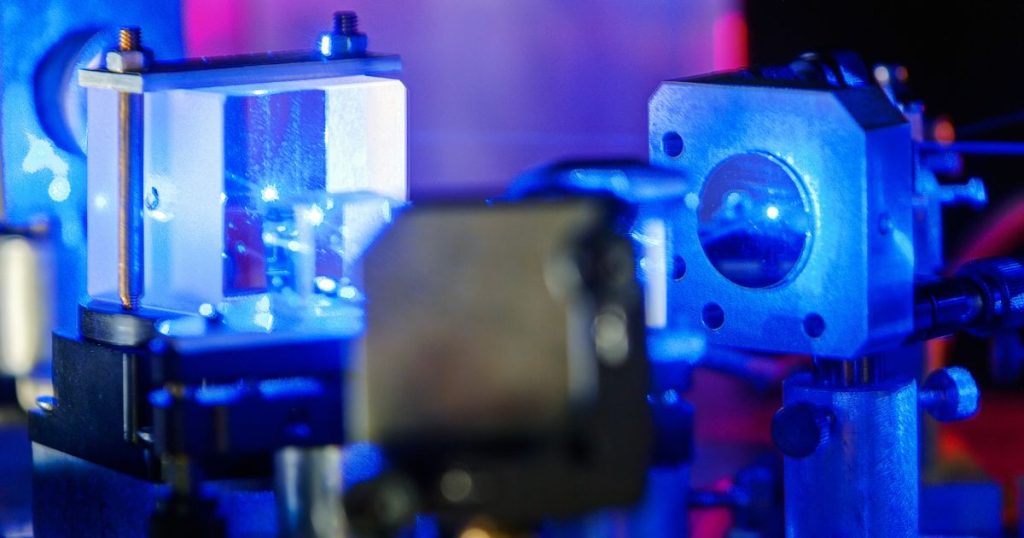
At around 450 nm, blue light is a wavelength at which standard IR-optimized coatings and substrates don’t perform well. Anti-reflection and high-reflectivity coatings must be specifically tuned for this shorter wavelength, since a coating designed for 1064 nm won’t transmit or reflect efficiently — or survive — at 450 nm. Substrate selection matters too: fused silica remains a strong choice for its transmission and damage resistance, but coating design and layer stack-up must account for blue light’s shorter wavelength and the correspondingly tighter tolerance requirements.
There’s also a power and thermal dimension. Many blue laser systems used in industrial welding and processing operate at high continuous power, and blue diode arrays are frequently combined — spatially or via fiber coupling — to reach the power levels needed for production-scale work. That combining process introduces its own optical requirements, and the optics downstream of it need to handle a beam that may have a different spatial or thermal profile than a single-emitter source.
2. The Absorption Physics Behind the Blue Laser Shift
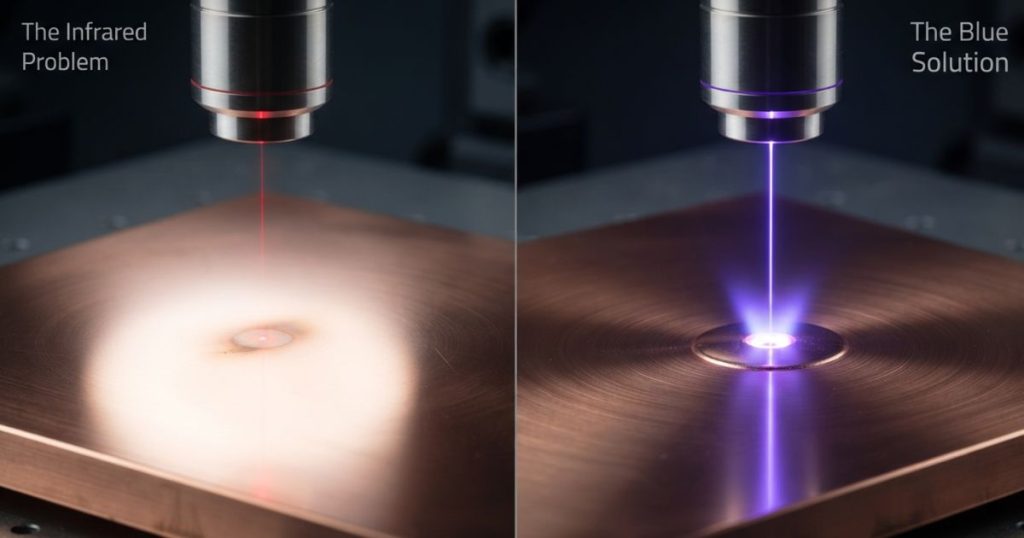
It’s worth pausing on why blue lasers have gained ground so quickly, because the reasoning directly shapes what optics engineers actually need to prioritize. Metal absorption of laser light is strongly wavelength-dependent, and for highly reflective metals like copper, gold, and aluminum, that dependence is dramatic. At typical near-infrared wavelengths around 1064 nm, copper reflects a large majority of incident light at room temperature, meaning much of an IR laser’s power is simply wasted — bounced away rather than absorbed into the workpiece. As the metal heats up during processing, absorption improves, but that creates an unstable, threshold-driven process: weld quality can swing sharply based on small variations in surface condition, heating history, or beam positioning.
Blue light around 450 nm behaves very differently. Copper’s absorption at blue wavelengths is dramatically higher than at IR wavelengths even at room temperature, which means the process starts in a stable, predictable absorption regime rather than depending on a thermal runaway effect to get going. In practice, this translates into more consistent weld penetration, reduced spatter, and better repeatability — particularly valuable in high-volume manufacturing environments like EV battery production, where weld consistency across thousands of joints directly affects yield and safety.
This absorption advantage is the entire reason blue laser optics exist as a distinct category. But it also means that any inefficiency introduced by the optics — a coating that reflects more than it should, a lens that distorts beam quality, or contamination that absorbs power at the wrong point in the beam path — works directly against the reason the system was built with a blue laser in the first place.
3. Key Factors to Consider When Selecting Blue Laser Optics
3.1 Coating Design for the Specific Wavelength Band
Blue diode lasers aren’t perfectly monochromatic — output can span a narrow band around the nominal wavelength, and that band can shift slightly with temperature and drive current. Optics should be specified with AR and HR coatings designed around the laser’s actual operating band, not just its nominal center wavelength. This matters more for blue optics than for many IR systems, since coating performance tends to be more sensitive to small wavelength shifts at shorter wavelengths — a coating optimized narrowly for 445 nm may already show measurable transmission loss by 455 nm, well within a diode array’s normal operating drift.
It’s also worth asking a supplier how their coating design accounts for angle of incidence, since coatings that perform well at normal incidence can shift their reflectivity curve at the angles actually present in a compact welding head layout.
3.2 Damage Threshold at Operating Power
High-power blue laser systems — increasingly common in welding and additive manufacturing — place real stress on optics, particularly at the collimating lens and any focusing or protective window closest to the workpiece. Damage threshold specifications should be evaluated against actual operating power and duty cycle, not just peak laser rating, since sustained high-average-power operation stresses coatings differently than short pulsed exposure.
A laser-induced damage threshold (LIDT) figure measured under short-pulse test conditions doesn’t necessarily predict how a coating holds up under continuous-wave operation at full duty cycle for months. Where possible, ask suppliers for damage threshold data measured under conditions resembling your actual application.
3.3 Beam Combining and Delivery Architecture
Because many industrial blue laser systems reach usable power through combining multiple diode emitters, the optics involved — beam combiners, collimating lenses, and fiber-coupling components — need to be matched to that specific architecture. A mismatch here doesn’t just reduce efficiency; it can degrade beam quality (M²) in ways that directly affect weld or process consistency downstream.
3.4 Protective Windows and Contamination Resistance
In welding and processing applications, protective windows sit closest to the work zone and bear the brunt of spatter, fumes, and debris. These need to combine high transmission at the blue wavelength with coatings resistant to contamination buildup, since even light surface fouling can meaningfully absorb power at short wavelengths and lead to thermal damage over time.
3.5 Thermal Stability of the Full Optical Path
High continuous power and tight focusing tolerances mean thermal lensing and focus drift are real concerns in blue laser systems. Optics — and the mounts and housings around them — need to be evaluated for thermal stability across the system’s actual duty cycle, not just a lab-bench spec sheet number.
3.6 Application-Specific Focus and Spot Size Requirements
Copper welding, battery tab and busbar welding, brazing, and additive manufacturing each demand different spot sizes, working distances, and depth-of-focus characteristics. A focusing lens optimized for fine-feature welding won’t necessarily suit a broader cladding or additive manufacturing process, so optics selection should start from the specific process requirement rather than a generic “blue laser lens” catalog entry.
4. Common Applications Driving Blue Laser Optics Demand
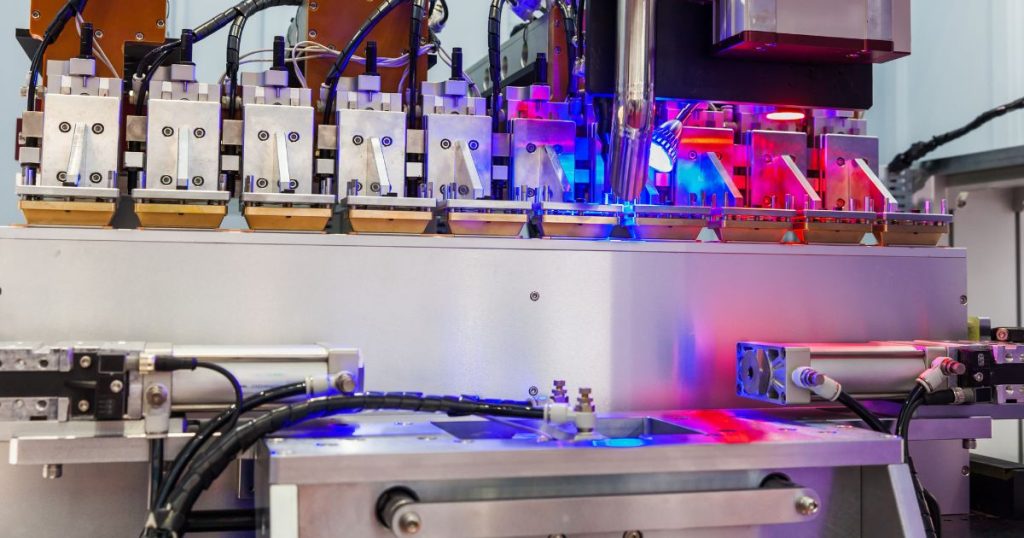
While copper welding remains the flagship use case — driven heavily by electric vehicle battery and motor manufacturing — blue laser optics are showing up across a growing set of industrial applications:
- Copper and busbar welding in EV battery pack and power electronics manufacturing, where blue’s superior copper absorption improves weld consistency and reduces spatter compared to IR systems.
- Battery tab welding, where thin, highly reflective foils benefit from blue light’s more predictable, stable absorption behavior.
- Hairpin motor winding welding, an increasingly common e-mobility application where copper hairpins need precise, repeatable joints.
- Brazing of copper and copper-alloy components, where blue’s absorption advantage allows for cleaner, more controlled heat input.
- Additive manufacturing, where blue lasers are being explored for printing with copper and other reflective metal powders that are difficult to process with traditional IR-based systems.
5. Materials Worth Knowing About
While fused silica remains the default substrate for most blue laser optics, a few material considerations tend to come up specifically in blue-wavelength system design:
- Optical coating uniformity becomes more visible at shorter wavelengths — small variations in coating thickness that would be inconsequential for an IR system can produce measurable wavefront distortion in a blue beam, which matters for applications like additive manufacturing where fine beam control affects print quality.
- Anti-reflection coating durability under blue light exposure is a genuine differentiator between suppliers, since blue photons carry more energy than IR photons and can degrade under-engineered coatings faster than expected under sustained high-power operation.
- Housing and mount materials matter more than they might seem to. High continuous power blue systems generate real thermal load, and mounts that don’t dissipate heat effectively can allow small amounts of lens movement over a shift, gradually degrading focus precision in ways easily misdiagnosed as a laser source issue.
6. Common Mistakes When Specifying Blue Laser Optics
A few recurring mistakes show up when teams move from IR or fiber laser systems into blue laser applications for the first time:
- Reusing IR-era assumptions about damage threshold. A damage threshold that felt conservative for a 1064 nm system doesn’t automatically transfer to a 450 nm system — treating blue optics like “IR optics with a different coating” can lead to underspecified components.
- Underestimating beam-combining effects. Teams sometimes specify downstream optics based on a single-emitter beam profile, then discover a combined multi-emitter beam has different divergence characteristics the chosen optics weren’t designed to handle cleanly.
- Treating protective windows as an afterthought. A poorly coated or under-specified protective window is often the first point of failure in a blue laser welding head, since it sits closest to spatter and debris while carrying full beam power.
- Skipping supplier validation data. Asking for real operating data — not just lab-bench specifications — is a reasonable and increasingly common request in a category this new.
7. A Practical Selection Checklist
When evaluating for a new or upgraded system, it helps to work through a short set of questions before requesting quotes:
- What is the laser’s actual operating wavelength band, including expected drift under load?
- What is the system’s continuous operating power and duty cycle — not just peak rating?
- Is the beam single-emitter or combined from multiple diodes, and how does that affect beam quality requirements downstream?
- What working distance and spot size does the specific application require?
- How exposed will protective optics be to spatter, fumes, or debris, and what contamination-resistance level is needed?
- Does the application call for a catalog-standard component, or does the mechanical envelope and beam geometry require a custom design?
Answering these up front tends to save significant time and cost compared to discovering a mismatch after a system is built and running below expectations.
8. Working with the Right Optics Partner
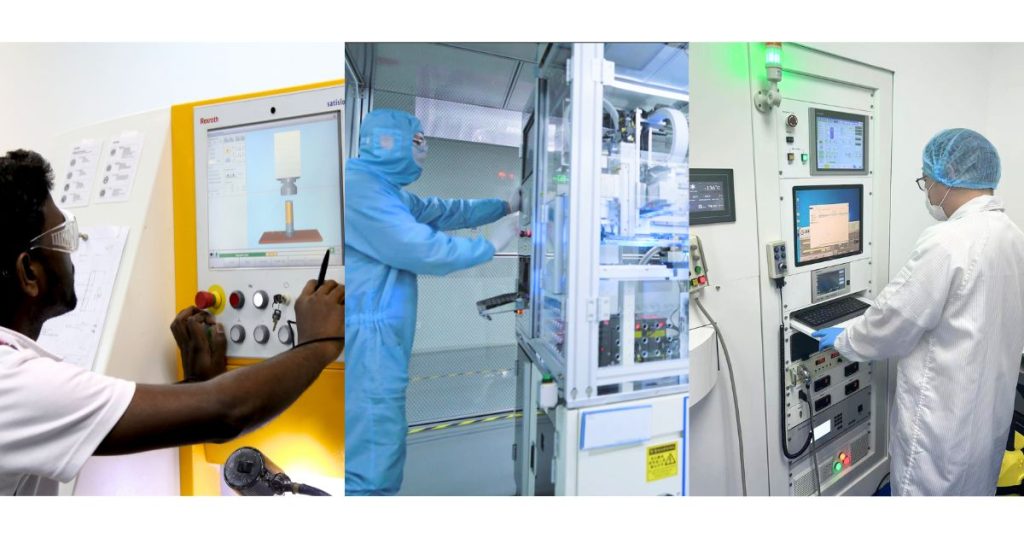
Because blue laser optics is still a relatively young category compared to IR, CO₂, or UV optics, not every optics supplier has deep, production-proven experience with blue-wavelength coatings and high-power blue beam delivery. Suppliers with a track record across multiple laser wavelengths — and the in-house coating and design capability to develop wavelength-specific solutions rather than adapt an IR product — tend to be a safer bet for applications where beam quality and reliability directly affect production yield, such as EV battery manufacturing.
Wavelength Opto-Electronic’s broader optics portfolio, spanning CO₂, UV, SWIR, and imaging optics, reflects the kind of multi-wavelength design and coating expertise that translates well into emerging categories like blue laser optics. Their catalog and custom capabilities cover the full blue laser beam-delivery chain, not just a single component:
F-theta scan lenses for blue laser systems. For blue laser marking, engraving, and precision scanning applications, Wavelength offers F-theta lenses designed to hold focus flat and consistent across the entire scan field at blue wavelengths — a must for galvanometer-based systems where field curvature or off-axis focus drift would otherwise degrade mark quality or feature precision toward the edges of the working area. As with their UV and IR lens lines, these are built with mounting adapters compatible with major galvo scan head brands, which simplifies integration for OEMs designing new blue laser platforms.
Beam expanders matched to blue wavelength requirements. Getting the right input beam diameter and divergence into a scan lens or focusing head is just as important at blue wavelengths as anywhere else, and Wavelength’s fixed and zoom beam expander lines — including motorized options for production environments that need repeatable, remotely adjustable magnification — can be specified with coatings tuned for blue-wavelength transmission and high damage threshold, supporting the tighter tolerances blue systems demand.
High-reflectivity mirrors for blue beam delivery. Steering a blue laser beam through a welding head, scanning system, or beam-combining path calls for mirrors with coatings specifically optimized for blue wavelengths and high continuous power — not repurposed IR or broadband coatings that quietly bleed efficiency at 450 nm. Wavelength’s laser line mirrors are engineered for high reflectivity and high laser damage threshold, which matters directly for blue systems running at sustained high power in welding and processing applications.
Protective windows and other beam-path components. Beyond the core focusing and steering optics, Wavelength’s capabilities extend to protective windows and other components positioned closest to the work zone — exactly where blue laser welding heads see the most exposure to spatter and debris, and where coating durability has the biggest impact on system uptime.
Custom design when off-the-shelf isn’t enough. Given how new blue laser welding and processing systems often are, many OEMs are still finalizing beam architecture, working distance, or mechanical envelope requirements — which is where Wavelength’s in-house custom optics design and coating development become genuinely useful rather than a nice-to-have. Rather than adapting a mismatched IR or UV component, teams can work directly with Wavelength’s engineering team to specify lenses, mirrors, and beam expanders built around the actual laser source, power level, and application from the start.
For manufacturers moving into blue laser welding or processing for the first time, this kind of consultative, cross-wavelength experience — backed by a single supplier who can deliver the scan lens, beam expander, and mirror as a matched set — is often as valuable as the components themselves.
9. The Takeaway
Blue laser optics solve a real, physics-driven problem — copper and other reflective metals simply don’t absorb IR light well, and blue wavelengths close that gap. But realizing that advantage in production depends on optics specifically engineered for blue’s shorter wavelength, higher power demands, and the beam-combining architectures common in industrial blue laser systems. Whether you’re specifying optics for copper welding, battery manufacturing, brazing, or additive manufacturing, starting from the application’s actual power, beam architecture, and spot-size requirements — rather than treating blue optics as a drop-in substitute for IR components — is the difference between a system that performs and one that underdelivers.
